
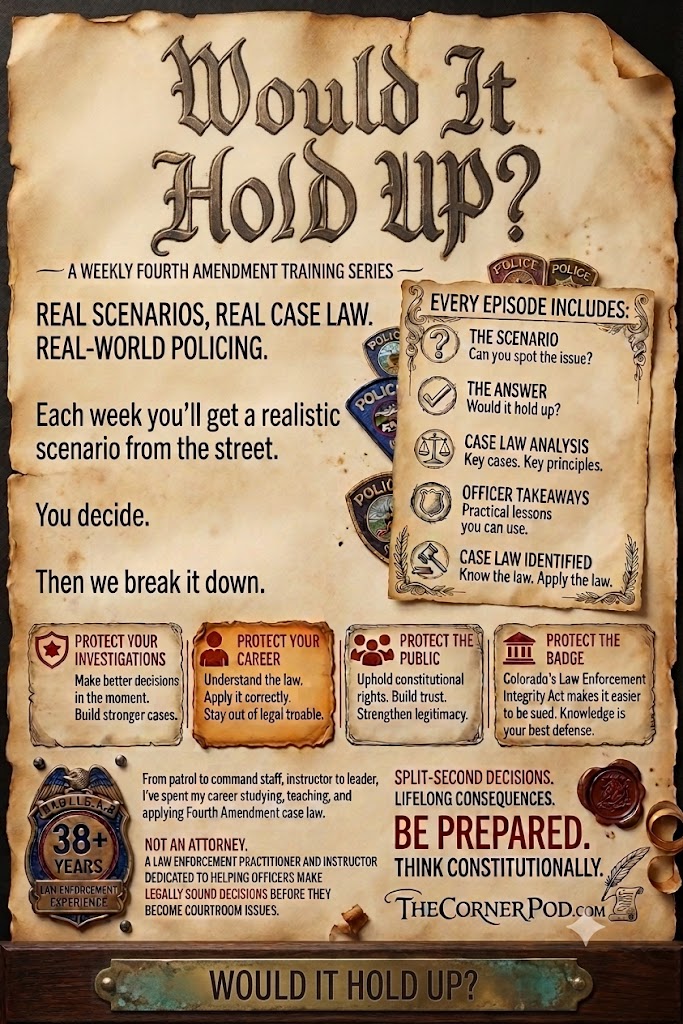
Weekly Fourth Amendment Challenge
Real scenarios. Real case law. Real officer takeaways.
Each week, Would It Hold Up? challenges officers to apply Fourth Amendment principles to real-world policing situations before reviewing the legal analysis and case law.
Each Scenario Includes:
The Call
The Question
Would It Hold Up?
Case Law Analysis
Officer Takeaways
Colorado Considerations
Why This Weekly Training Series Exists
Every day, law enforcement officers make decisions that can determine whether evidence is admitted or suppressed, whether an arrest withstands judicial scrutiny, and whether an officer faces personal legal exposure.
The challenge is that the Fourth Amendment is not static. It evolves continuously through decisions issued by the United States Supreme Court, the Tenth Circuit Court of Appeals, and Colorado appellate courts. Officers are expected to know and correctly apply these decisions—often in rapidly developing situations where there is little time to stop and research the law.
That is why I created Would It Hold Up?
Each week, I present a realistic scenario based on situations officers encounter every day. Before revealing the answer, I encourage you to make the decision yourself. Then we’ll walk through the legal analysis, examine the controlling case law, identify the key constitutional principles, and discuss practical officer takeaways that can be applied immediately on the street.
This series is not about memorizing hundreds of court cases. It is about learning how to think constitutionally.
When officers understand the legal principles behind the decisions, they become more confident, make better decisions under pressure, write stronger reports, conduct more lawful investigations, and better protect the rights of the people they serve.
The stakes have never been higher. In Colorado, the passage of the Law Enforcement Integrity Act significantly increased accountability for officers and made it easier for individuals to pursue claims in state court for constitutional violations. A misunderstanding or misapplication of Fourth Amendment law can have consequences far beyond the suppression of evidence. It can affect an officer’s career, expose the officer to personal liability, damage public trust, and undermine an otherwise solid criminal case.
Knowledge is one of the best forms of protection.
For more than 38 years, I have served in law enforcement with the Los Angeles County Sheriff’s Department, the Aurora Police Department, the Loveland Police Department, and the Dacono Police Department. During that time, I have worked as a patrol officer, gang investigator, detective, sergeant, lieutenant, captain, commander, deputy chief, interim chief, and law enforcement instructor. I have spent more than two decades teaching Practical Search and Seizure to thousands of law enforcement officers and numerous prosecutors and defense attorneys throughout Colorado.
I am not an attorney, nor do I claim to be one. I am a law enforcement practitioner and instructor who has dedicated a significant portion of my career to studying, teaching, and applying Fourth Amendment case law in real-world policing.
My goal is simple: To help officers make legally sound decisions before they become courtroom issues.
If these weekly scenarios cause you to pause, think critically, and leave with one practical lesson you can use on your very next shift, then they have accomplished exactly what they were designed to do.
Because when the lights are flashing, the radio is busy, and the decision has to be made in seconds, there is only one question that really matters…
Would It Hold Up?